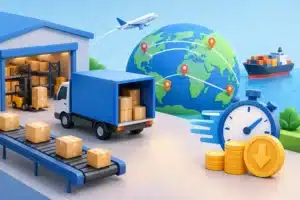
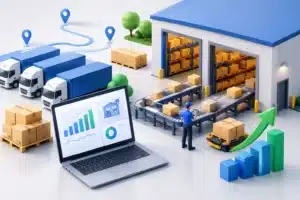
A single warehouse can look efficient right up until parcel invoices, delivery complaints, and abandoned carts say otherwise. For national sellers, distributed fulfillment for ecommerce brands is not about adding complexity for its own sake. It is a practical way to put inventory closer to demand, reduce the distance each package travels, and make fast ground delivery achievable without paying for premium air service.
For brands between $2 million and $50 million in revenue, this shift often comes at a critical point. You have outgrown the simple economics of shipping everything from one building, but you do not need – or want – an enterprise 3PL contract with enterprise-level overhead, inflexible rules, and a support queue when something goes wrong.
Why one-node fulfillment stops working
A central fulfillment center gives a young brand one inventory position, one operating team, and one set of processes to manage. That simplicity has real value. If most customers live within a few states of the warehouse, a single-node model may remain the right answer.
The trouble starts when customer demand is spread across the country. A package leaving New Jersey for California, or leaving Southern California for the Northeast, crosses multiple parcel zones. The order costs more to ship, takes longer to arrive, and becomes more exposed to weather delays, carrier exceptions, and peak-season disruption.
For lightweight products with strong margins, those problems may be tolerable for a while. For heavier products, dimensional shipments, subscription boxes, or orders with multiple items, they become expensive quickly. The brand sees rising landed fulfillment costs even when order volume is growing.
This is also where many operators make the wrong comparison. They look only at warehouse pick-and-pack rates. That is not the number that determines whether a fulfillment strategy works. The meaningful number is total cost per delivered order: storage, receiving, pick fees, packaging, parcel spend, accessorial charges, claims, and the customer-service cost of late delivery.
What distributed fulfillment for ecommerce brands changes
Distributed fulfillment places inventory in two or more regional warehouses based on where customers actually live. A brand might hold inventory in the East, Central, and West regions rather than ship every order from one coast.
The goal is not to open warehouses everywhere. The goal is to create a network with enough geographic coverage that the majority of orders move through short, inexpensive ground lanes. For many national ecommerce brands, the right regional footprint can support 90% or more 2-day ground coverage without upgrading every shipment to an expensive expedited service.
That changes the operating equation in three ways.
First, average shipping zones come down. Lower zones generally mean lower parcel costs, particularly for products where weight and dimensions make long-distance shipping painful.
Second, transit times become more predictable. Ground service from a nearby regional facility is less dependent on perfect carrier performance than a package traveling across the country. Two-day ground is not a marketing promise if an order has to travel five or six zones to get there. It is a network design decision.
Third, the customer experience improves without forcing the brand to absorb a margin-killing shipping subsidy. Faster delivery helps conversion and repeat purchase, but it also reduces the “Where is my order?” tickets that consume a support team after the sale.
The real trade-off: inventory versus parcel cost
No credible fulfillment partner should pretend a multi-node strategy has no trade-offs. Distributed inventory means carrying inventory in more than one location. That can raise total safety-stock requirements and requires better demand planning.
If a brand has highly volatile demand, a very broad catalog, or slow-moving SKUs, splitting every item across every warehouse is usually a mistake. You can end up with inventory stranded in the wrong region while another facility stocks out.
The answer is not to abandon the model. It is to design it intelligently. High-volume, predictable products are typically the best candidates for broad regional placement. Long-tail SKUs, oversized items, bundles with special handling needs, or unpredictable seasonal products may belong in fewer nodes.
A capable network should make those decisions SKU by SKU, not apply a one-size-fits-all inventory rule. The question is not, “Can we ship from three warehouses?” The question is, “Which inventory belongs in each location to lower delivered cost without creating avoidable stock risk?”
When a regional network makes financial sense
The best trigger for a distributed model is not a revenue milestone alone. It is the combination of geographic demand, parcel spend, product profile, and service expectations.
A brand shipping nationally from a single location should examine its order map. If a large share of shipments travel to distant zones, there is likely an opportunity. The opportunity gets stronger when those orders are heavy, dimensional, or frequently sent with free-shipping offers.
It also depends on order density. A brand with meaningful customer volume in the Northeast, Midwest, and West Coast can often justify regional inventory more easily than a brand whose demand is concentrated in one market. The same is true for brands with repeat purchase behavior. Faster delivery may have an ongoing effect on retention, not just a one-time improvement in delivery speed.
Seasonality matters, too. A network must be able to rebalance inventory ahead of peak periods, promotions, and product launches. A cheaper zone map on paper is not useful if the West facility runs out of a top seller during Black Friday and every order suddenly ships from the East Coast.
Avoid the enterprise 3PL trap
Large fulfillment providers sell scale, and scale can be useful. But scale alone does not solve operational problems. Many growing brands discover that an enterprise 3PL provides a national footprint while creating a different set of headaches: long implementation cycles, standardized processes that do not fit the product, ticket-based support, rigid minimums, and limited access to decision-makers.
That model works for some companies. It is a poor fit for brands that need responsive operational guidance, have complex products, or cannot afford to be treated like a small account inside a very large system.
A coordinated network of independent regional operators offers a different approach. The brand gets national reach, but each facility remains close enough to the operation to be accountable. Local teams understand their building, their carrier relationships, and the details that affect daily performance. A coordinated network provides the planning, reporting, and inventory strategy needed to make those regional teams operate as one fulfillment model.
That combination matters. Fragmented warehouses without shared standards create confusion. A giant provider with no real ownership of the account creates frustration. The right model gives a brand both coordination and access to people who can fix problems.
What to ask before expanding to multiple nodes
Before moving inventory, get clear answers on how the network will operate. Do not accept vague promises about “nationwide coverage.” Ask how orders are routed, how inventory is allocated, what happens when a facility is out of stock, and who owns the escalation when service fails.
You should also understand the reporting. A useful fulfillment partner can show average shipping zone, transit-time performance, on-time shipment rate, order accuracy, parcel cost by region, and inventory levels by node. If the data is only available in a monthly spreadsheet after the fact, you will have trouble managing the network proactively.
Pricing deserves the same scrutiny. Compare the full delivered-order cost, not just a low pick fee or an attractive initial rate card. Look for receiving charges, storage thresholds, minimums, packaging markups, special-project fees, carrier surcharges, and contract terms that make it costly to adapt as your business changes.
Finally, ask who will be available after implementation. Ecommerce Fulfillment Alliance was built around the idea that growing brands should not have to choose between national reach and direct, accountable service. That is not a soft benefit. When inventory is misplaced, a launch goes live, or a carrier issue threatens a promotion, access to the right operator matters.
Start with the order map, not the warehouse map
The right fulfillment footprint begins with customer demand, not with a provider’s available buildings. Pull the last 6 to 12 months of order data and look at where orders ship, what they cost, how long they take to arrive, and which products create the biggest parcel burden.
From there, model a small number of regional scenarios. For many brands, two or three well-placed nodes produce most of the benefit. More locations are not automatically better. Every additional node adds inventory and operational complexity, so it should earn its place through lower parcel costs, faster coverage, or meaningful risk reduction.
A better network is not the one with the most warehouse pins on a map. It is the one that gives your customers faster, more reliable delivery while preserving the margin and flexibility your business needs to keep growing.