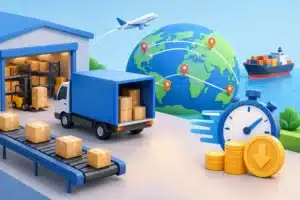
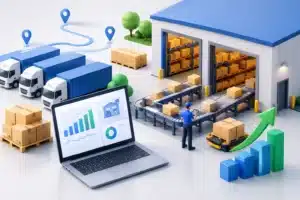
A brand shipping from one warehouse in New Jersey can reach nearby customers quickly and cheaply. Ship that same order to California, Texas, or the Pacific Northwest, and the economics change fast. That is the real decision behind centralized versus decentralized inventory: not a warehouse theory exercise, but a choice that affects parcel spend, delivery promises, working capital, and how much operational complexity your team can absorb.
For many ecommerce brands between $2M and $50M in revenue, the answer is not all-or-nothing. A single fulfillment center may be the right starting point. A carefully planned multi-node network may be the next move. The mistake is treating national distribution as a badge of scale rather than a financial and customer-service decision.
Centralized versus decentralized inventory: the core difference
Centralized inventory means holding most or all sellable inventory in one fulfillment center. Every order is picked, packed, and shipped from that location. The model is simple to manage, easier to count, and usually requires less total safety stock.
Decentralized inventory means dividing inventory across two or more warehouse locations. Orders ship from the facility closest to the customer whenever inventory is available there. The goal is to reduce average shipping zones, lower parcel costs, and put more customers within two-day ground reach.
Neither model is automatically better. Centralization prioritizes control and inventory efficiency. Decentralization prioritizes transportation efficiency and delivery speed. The right choice depends on where your customers live, what you sell, how predictable demand is, and whether your fulfillment partner can coordinate multiple locations without creating a new set of problems.
When centralized inventory makes sense
A centralized model is often the best fit for earlier-stage brands, brands with a narrow SKU catalog, or businesses with slower-moving and highly variable demand. One inventory pool reduces the odds that a popular item is sitting in the wrong warehouse while another location runs out.
It also makes replenishment straightforward. You send inbound freight to one destination, receive against one process, and maintain one primary inventory record. For a lean operations team, that simplicity has real value. Fewer transfers, fewer split decisions, and fewer places for inventory discrepancies to hide.
Centralization can be especially practical when products are lightweight and shipping costs are relatively forgiving. If a customer in Arizona can receive a small parcel from Ohio at an acceptable cost and transit time, adding a West Coast node may not generate enough savings to justify the extra inventory and operating complexity.
The downside shows up when a large share of orders travel across the country. A brand shipping nationally from one East Coast location may regularly pay for Zones 7 and 8 shipments to western customers. Those orders cost more, take longer, and are more exposed to weather, carrier disruptions, and peak-season delays. A single warehouse can also become a single point of failure if a storm, labor issue, systems outage, or inbound delay affects the operation.
When decentralized inventory earns its keep
Decentralized inventory becomes compelling when parcel spend is climbing, customers are concentrated in regions far from your current warehouse, and two-day delivery is becoming a competitive expectation. Rather than paying to send every western order across the map, you position fast-moving inventory closer to demand.
For many national ecommerce brands, two or three strategically chosen nodes can materially reduce average zones. That usually means more ground shipments, fewer expensive long-distance parcels, and a more credible delivery promise without automatically paying for air service.
The benefit is especially strong for heavier, oversized, or dimensional products. A one-pound apparel item and a bulky home goods order do not feel parcel costs the same way. For dimensional products, reducing shipping distance can change the margin profile of an order. It is often the difference between a shipping program that supports growth and one that quietly taxes every new customer acquisition dollar.
A decentralized model also adds resilience. If one facility is temporarily constrained, inventory in another region can help keep orders moving. That does not eliminate disruption, but it gives your operation options that a single-node network does not have.
The trade-off is inventory fragmentation. If you carry 500 units of a best-selling SKU in one warehouse, you have 500 units available to every order. Spread that stock across three nodes, and each location needs enough inventory to avoid stockouts. Poor demand forecasting can leave you with excess inventory in one region and a shortage in another, even when total on-hand units look healthy.
The hidden cost is not always the warehouse bill
Brands often compare fulfillment quotes by looking at pick fees, storage rates, and inbound charges. Those numbers matter, but they do not answer the network question.
The larger financial picture includes parcel-zone costs, residential surcharges, dimensional weight, split shipments, inventory carrying cost, transfer freight, and lost conversion or repeat purchases caused by slow delivery. A lower pick fee does not help much if the provider ships most orders from a warehouse that is five zones away from your customers.
On the other side, more locations are not free savings. Each node requires inbound planning, cycle counting, replenishment discipline, and inventory allocation rules. Adding warehouses before there is enough order volume can increase fixed costs and make fulfillment harder to manage.
This is why a multi-node strategy should be designed around actual order data, not a generic map. Review at least 6 to 12 months of shipments by destination ZIP code, order weight, dimensions, carrier service, and SKU. Then model what would happen if the same orders shipped from one, two, or three locations. The question is not whether decentralized fulfillment sounds faster. The question is whether the transportation savings and delivery improvement exceed the added inventory and operating costs.
A practical way to make the decision
Start with your customer geography. If most orders are within a few zones of your current fulfillment center, centralization may still be doing its job. If a meaningful portion of orders are consistently crossing the country, a regional node deserves serious analysis.
Next, look at product behavior. Fast-moving, predictable A-items are usually the easiest inventory to place in multiple locations. Slow-moving, seasonal, highly variable, or long-tail SKUs often belong in a central location until demand proves otherwise. Not every product needs to be stocked in every warehouse.
Then assess your service promise. If your site promotes fast delivery, or your competitors are winning customers with two-day shipping, fulfillment geography becomes a customer experience issue. Customers may not care where an order ships from, but they notice when a package takes six days to arrive after they have already paid for shipping.
Finally, pressure-test your operational readiness. Can your systems accurately route orders to the right node? Can your team forecast inventory by region? Does your 3PL provide transparent inventory visibility and a clear escalation path when stock is misplaced or an order is routed incorrectly? A decentralized network without real coordination can feel like managing several unrelated vendors.
The hybrid model is often the practical answer
Many growing brands do not need to choose between one warehouse and full national inventory duplication. A hybrid approach can deliver the strongest economics.
In this model, a central location holds the full catalog and deeper reserve inventory. Regional locations stock proven fast movers based on local demand. Orders for common items ship from the nearest node, while long-tail products ship from the central facility. This limits the amount of safety stock tied up across the network while still reducing zones for a large share of shipments.
The model requires good rules. You need clear reorder points, a defined transfer cadence, and a plan for what happens when a regional node runs out. It also requires fulfillment partners that work as a coordinated network, not a collection of warehouses passing accountability back and forth.
That is where a network built from capable regional operators can be different from an enterprise 3PL model. The goal is national coverage without losing the local warehouse accountability, executive access, and flexibility that growing brands tend to lose inside large, rigid fulfillment contracts.
Do not decentralize just to say you have multiple nodes
Multi-node fulfillment can be a major advantage, but it is not a cure for weak forecasting, unclear inventory ownership, or a poor 3PL relationship. Adding locations will not fix bad data. It will multiply its consequences.
Likewise, staying centralized because it feels simpler can become expensive inertia. If parcel costs are rising while a growing share of orders travels six or seven zones, the single-node model may be costing more than it saves.
The best inventory strategy is the one that gives your customers a better delivery experience while protecting margin and keeping your operation manageable. Start with shipment data, identify where distance is hurting you, and expand only when the numbers support it. National fulfillment should make growth easier, not add an enterprise-sized headache to your business.