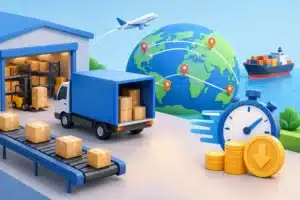
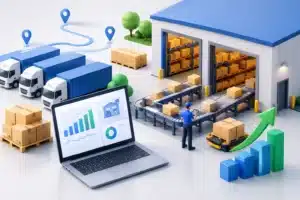
A single warehouse can feel like the sensible choice when a brand is getting started. Inventory sits in one place, inbound freight has one destination, and the operating model appears easy to manage. But once customers are spread across the country, the single warehouse versus networked fulfillment decision becomes a direct question of margin, delivery speed, and customer experience.
For a brand shipping nationally, fulfillment is not just a pick-and-pack expense. It determines how many zones each order travels, how much parcel carriers charge, whether ground shipping can meet customer expectations, and how often your team has to explain late deliveries. The right model is not the one with the simplest sales pitch. It is the one that fits your order profile, inventory economics, and growth plan.
The Real Cost of a Single Warehouse
A single warehouse concentrates inventory and simplifies some operational tasks. There is one receiving team, one inventory pool, and one set of warehouse processes to monitor. For a young brand with low volume, a concentrated customer base, or products that are expensive to store in multiple locations, that simplicity has real value.
The problem starts when demand is national. A warehouse in the Midwest may serve central customers efficiently while sending West Coast and East Coast orders across four, five, or more shipping zones. A facility near either coast creates the same issue in the opposite direction. Those long-zone shipments cost more, take longer, and are more exposed to weather, carrier disruptions, and missed delivery promises.
This pressure is especially sharp for heavier products, oversized cartons, and dimensional shipments. When package weight or size drives parcel cost, shipping a box across the country can erase the savings gained from keeping inventory under one roof. Brands often focus on their warehouse rate while missing the larger line item: parcel spend.
A single-node model also limits your ability to offer fast ground delivery without paying for air. If a customer expects an order in two days but your warehouse is 2,000 miles away, expedited service becomes the only reliable answer. That is not a scalable fulfillment strategy. It is a margin leak.
When One Warehouse Still Makes Sense
Networked fulfillment is not automatically the right answer for every business. Splitting inventory adds planning requirements. You need to forecast regional demand, replenish multiple locations, and maintain enough stock at each node to avoid preventable split shipments or stockouts.
A single warehouse can remain the better fit when most customers live within a few ground zones of one facility, order volume is still modest, or the catalog contains slow-moving items that would be difficult to distribute intelligently. It can also work well for brands with highly customized products, strict handling requirements, or inventory so limited that dividing it would hurt availability.
The key is to make the decision based on data, not habit. Review where orders actually ship, the average zone by destination, parcel spend by zone, delivery times, and the share of customers receiving orders within two days by ground. If your current node already reaches the bulk of buyers quickly and affordably, adding facilities may create complexity without meaningful return.
But if a meaningful percentage of orders are crossing the country, a centralized model may be costing more than it saves.
Single Warehouse Versus Networked Fulfillment: The Practical Difference
A networked model positions inventory across two or more regional fulfillment centers. Rather than every order leaving from one building, each order is routed from the location that can serve the customer most efficiently while inventory availability allows.
The goal is not to put inventory in every major city. That creates unnecessary storage, replenishment, and management costs. The goal is to place the right inventory in a small number of well-positioned nodes so the majority of customers are within one- or two-day ground reach.
For many mid-market ecommerce brands, two or three strategically located warehouses can materially reduce average shipping zones. A common approach is to use a central location with an East or West Coast partner, then adjust based on actual demand patterns. A brand with concentrated California demand needs a different footprint than one whose orders cluster across the Northeast, Texas, and the Southeast.
Done well, a network can support 90% or more of customers with two-day ground coverage. That means faster delivery without defaulting to costly expedited methods. It also gives brands more leverage when setting customer-facing shipping promises. Two-day delivery stops being a marketing claim funded by air freight and becomes an operational capability supported by ground service.
Where the Savings Actually Come From
The strongest case for a network is usually parcel economics. Shorter average zones often mean lower shipping costs, particularly for products with meaningful billable weight. The savings may be enough to offset the added expense of storing and handling inventory at multiple sites, but that needs to be modeled rather than assumed.
Transit time is the second major gain. Faster ground shipping improves the customer experience and reduces the risk that a carrier delay turns into a support ticket, a refund request, or a negative review. Customers do not care that a warehouse processed an order on time if it still takes six days to reach their doorstep.
There is also a resilience benefit. When all inventory sits in one building, a local weather event, labor disruption, carrier issue, or facility-level problem can affect every order. Multiple nodes do not eliminate risk, but they give a brand options. If one location has a temporary constraint, another may be able to absorb some volume or serve nearby demand.
That said, a network creates its own costs. Inbound inventory may need to be allocated across locations. Replenishment needs discipline. Inventory accuracy across every node matters. A poorly coordinated network can create split shipments, uneven stock levels, and more operational noise than it removes.
The Decision Should Start With Your Order Data
Before changing fulfillment strategy, map the last six to 12 months of orders by customer ZIP code, package profile, and shipping service. Look at the average zone today, the cost by zone, the percentage of orders delivered in two days by ground, and the geographic concentration of revenue.
Then compare the current model with realistic network scenarios. Do not use a generic warehouse map or a 3PL’s preferred footprint as the answer. Model your catalog, your customer distribution, your peak season volume, and your actual carrier rates.
A useful analysis also accounts for inventory velocity. Fast-moving core SKUs are usually the best candidates for multi-node placement. Long-tail products may be better held centrally, depending on order frequency and storage cost. Not every SKU has to live at every warehouse for a network to work.
This is where many large providers fall short. They sell a national footprint, then force brands into a standard configuration with limited flexibility and limited executive attention. A better model lets the fulfillment footprint follow the business, not the provider’s operating chart.
What to Demand From a Multi-Node Partner
If you move to a networked model, coordination matters as much as geography. Separate regional warehouses are not automatically a fulfillment network. The locations need shared operating standards, clear inventory visibility, dependable order routing, and accountability when something goes wrong.
Ask practical questions. Who owns the customer relationship? How are routing decisions made? Can inventory be rebalanced before peak season? What happens if one node falls behind? Will you have access to people who can make decisions, or will issues disappear into a ticket queue?
Ecommerce Fulfillment Alliance is built around that distinction: national reach through accountable regional operators, without forcing growing brands into an impersonal enterprise contract. The point is not scale for its own sake. It is lower-friction execution that keeps fulfillment aligned with the commercial realities of your business.
The best next step is not to commit to more warehouses. It is to run the numbers honestly. If your orders are traveling too far, your customers are waiting too long, and parcel costs keep climbing, a smarter network may be the operational change that protects both growth and margin.