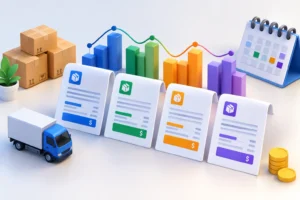
You hit the $10 million revenue mark. It is a massive milestone. But suddenly, your margins are thinning, and your customers in New York are complaining that their “2-day shipping” is taking six days to arrive from your California warehouse. This is the classic “scaling wall” where a single-facility setup stops being an asset and starts becoming a liability. To break through to the $50 million level, top-tier brands are moving toward multi node fulfillment to slash shipping costs and meet modern delivery expectations.
If you are still shipping every single order from one central location, you are likely overpaying for every cross-country package. The logic is simple: the further a package travels, the more it costs. For a brand at your scale, those extra “Zone 8” charges are not just a nuisance: they are a direct drain on your EBITDA.
IS YOUR SINGLE WAREHOUSE KILLING YOUR MARGINS?

Most ecommerce brands start in one warehouse because it is easy. One inventory pool, one point of contact, one set of problems. But as you grow, the “convenience” of a single warehouse becomes incredibly expensive. Carriers like UPS, FedEx, and DHL base their pricing on “Zones.” If you ship from Los Angeles to Miami, that is a Zone 8 shipment. It is the most expensive and slowest ground service available.
By implementing a multi node fulfillment strategy, you effectively “collapse” the map. Instead of shipping across eight zones, you position inventory so that the majority of your orders ship within Zones 1, 2, or 3.
The math is devastating for single-node brands:
- Zone 8 shipments: High cost, 5-7 day transit times, high risk of damage due to multiple touchpoints.
- Zone 2 shipments: 30-40% lower cost, 1-2 day transit times, higher customer satisfaction.
When you are doing $10M+ in revenue, a 20% reduction in shipping costs doesn’t just save a few dollars: it adds hundreds of thousands of dollars directly back to your bottom line. Unfortunately, many brands stay stuck in a single warehouse because they fear the complexity of splitting inventory. This is a mistake that allows leaner competitors to outpace you on price and speed.
CAN YOU REALLY HIT 2-DAY GROUND NATIONWIDE?
Amazon has trained your customers to expect their orders in 48 hours or less. If you are shipping from a single warehouse, the only way to compete with that speed is to pay for expensive air shipping. Ecommerce order fulfillment at scale shouldn’t require you to choose between your margins and your customer experience.

With a strategic network of fulfillment centers, you can achieve 90%+ 2-day ground coverage across the United States. This is the “holy grail” of logistics. You get the speed of air shipping with the price tag of ground shipping.
At Ecommerce Fulfillment Alliance, we help brands scale to multi node fulfillment without the red tape. By placing inventory in key regional hubs: like Los Angeles, Dallas, and Newark: you ensure that no matter where your customer lives, their order is already close to them.
TIRED OF BEING A SMALL FISH IN A BIG 3PL POND?
Many $10M brands think the only way to get national reach is to sign a restrictive contract with a “Mega 3PL” like ShipBob or Flexport. These startups often present themselves as tech companies, but their actual warehouse performance often leaves much to be desired.
Exercise extreme caution with “Enterprise” 3PLs:
- The Ticket Number Trap: When an order goes wrong, you are just a support ticket in a queue. You have no direct access to the people actually touching your product.
- Rigid Contracts: They want to lock you in for years, making it nearly impossible to leave if their service quality tanks.
- Standardized Inflexibility: If your product has unique needs: like heavy dimensional weight or complex assembly: these “automated” warehouses often struggle to handle it.
We believe ecommerce order fulfillment should be personal. Our alliance model gives you the national reach of a corporate giant but the “concierge-level” service of a regional operator. You get direct access to the management at each facility. If there is a problem on the floor, you can call the person in charge, not a call center in another country.
IS YOUR PRODUCT “TOO DIFFICULT” FOR TRADITIONAL 3PLs?

If you ship heavier items or products with high dimensional weight (DIM weight), you have likely noticed that many 3PLs penalize you with massive surcharges. Corporate 3PLs love small, light “pick-and-pack” items that fit in a standard mailer. They are often ill-equipped to handle freight-heavy ecommerce brands.
Strategic multi node fulfillment is even more critical for heavy products. Shipping a 30lb box across the country is exponentially more expensive than shipping it two states away. We specialize in these complex fulfillment needs. We don’t shy away from “difficult” SKUs; we build the infrastructure to handle them efficiently.
Whether you are dealing with furniture, fitness equipment, or large electronics, your ecommerce order fulfillment needs to be optimized for your specific product profile. Relying on a one-size-fits-all warehouse is a recipe for catastrophic shipping bills.
HOW TO TRANSITION WITHOUT THE CHAOS?
Moving to a distributed inventory model sounds daunting, but it is a standard evolution for growing brands. You do not need to move all your inventory overnight.
Key steps for a successful transition:
- Analyze Your Data: Look at your last 6 months of orders. Where are your customers? If 40% are on the East Coast and you are shipping from Utah, that is your first new node.
- Start Small: You don’t need five warehouses on day one. A simple East/West split often captures 70% of the potential savings.
- Choose the Right Partner: Avoid long-term lock-ins. You want a partner that earns your business every month.
- Integrate Your Tech: Ensure your WMS (Warehouse Management System) can intelligently route orders to the closest node automatically.
Effective ecommerce order fulfillment requires a partner who understands the nuances of regional shipping. You need someone who knows the local carrier schedules and the regional weather patterns that might delay your shipments.
THE $50M ROADMAP STARTS WITH LOGISTICS
A single warehouse is a safe harbor for a startup, but for a $10M brand, it is an anchor. To reach the next level of growth, you must stop viewing logistics as a cost center and start viewing it as a competitive advantage.
By embracing multi node fulfillment, you lower your costs, delight your customers with faster speeds, and build a more resilient supply chain. Don’t wait until your margins are crushed by the next carrier rate hike.
If you are ready to stop being treated like a number and start scaling like a leader, contact us at Ecommerce Fulfillment Alliance. We will help you map out a custom strategy that puts your inventory exactly where it needs to be.
ShipBob too Expensive? 5 Hidden Costs of Mega 3PLs You Can Cut Today