A brand can double order volume and still lose ground if every additional shipment costs more, travels farther, or creates another customer-service fire. That is the real challenge behind how to scale ecommerce fulfillment. Growth is not simply adding warehouse capacity. It is building an operating model that keeps delivery fast, parcel spend controlled, inventory accurate, and accountability close as national demand expands.
For brands in the $2M to $50M range, the wrong answer is often an oversized enterprise 3PL contract. It may promise national reach, but deliver rigid processes, slow support, and a pricing structure that gets worse as products become heavier, more dimensional, or more complex to handle. There is a better way: scale deliberately, with fulfillment decisions tied to the economics of every order.
Know When Your Current Fulfillment Model Has Hit Its Limit
Most brands do not need a new fulfillment strategy because they crossed an arbitrary revenue threshold. They need one because the current model is producing measurable friction.
Maybe a single warehouse once covered the business well, but West Coast customers now wait five or six days for delivery. Maybe parcel invoices keep rising despite carrier negotiations. Maybe peak periods expose weak receiving, picking, or inventory controls. Or perhaps your 3PL’s support team has become a ticket queue where urgent exceptions wait behind generic requests.
Those are not isolated annoyances. They are signs that fulfillment has become a constraint on growth.
Start by looking at the operational facts: average shipping zone, transit-time performance, cost per order, split-shipment rate, inventory accuracy, order turnaround time, and the percentage of customer orders that require manual intervention. If you cannot get clear answers from your current partner, that is also an answer.
A scalable operation should improve the customer experience as volume rises, not ask customers to tolerate slower service because the brand is growing.
How to Scale Ecommerce Fulfillment in the Right Order
The most reliable path is not to chase the biggest warehouse footprint. It is to solve the biggest cost and service problems first, then add capacity where the data supports it.
Start with your order and inventory profile
Before adding a second or third node, understand what actually ships. Review where orders go, which SKUs drive volume, how often customers buy multiple items, and whether products have unusual storage or handling needs. A compact, lightweight SKU set behaves very differently from bulky home goods, subscription bundles, or fragile products with kitting requirements.
This analysis determines whether distributed inventory will produce real savings. Two-node fulfillment can lower shipping zones dramatically for a brand with demand concentrated on both coasts. It can be less useful when inventory is shallow, product velocity is unpredictable, or a large share of orders consists of slow-moving long-tail SKUs.
The trade-off is straightforward: more nodes can cut parcel costs and transit time, but they also require more inventory planning. Do not scatter every SKU across every warehouse just because a network can support it. Place high-velocity products where demand justifies them, and keep slower items centralized until the economics change.
Use shipping zones as a growth metric
A warehouse may look efficient inside its four walls while quietly creating expensive shipping outside them. When most orders travel across five, six, seven, or eight zones, parcel costs climb and two-day delivery becomes difficult without paying for air service.
Regional distribution changes that equation. Inventory positioned in complementary locations can put a substantial majority of customers within two-day ground reach. For many national brands, 90% or more two-day ground coverage is a practical target when node placement matches the customer map.
That does not mean every brand needs five warehouses. Often, two or three well-selected regions deliver most of the benefit. The right network design depends on order density, carrier rates, product dimensions, and the cost of holding inventory in multiple places. A good fulfillment partner should show the assumptions behind its recommendation, not sell a generic map of warehouse pins.
Build inventory discipline before expanding nodes
Multi-node fulfillment is only as good as the inventory data behind it. If your system cannot reliably show what is available in each location, distributed fulfillment can turn into split shipments, stockouts, and expensive transfers.
Set clear replenishment rules for each node. Determine the minimum stock position, the lead time for replenishment, and who is responsible for approving transfers or inbound allocations. Your planning process should account for seasonality, promotions, marketplace demand, and inbound container timing, not just trailing sales averages.
It also helps to establish a practical exception process. What happens when one node runs out of a top SKU? Can orders route from another location automatically? When is a transfer cheaper than shipping from farther away? These decisions should be agreed upon before they are urgent.
Choose operational accountability over a giant logo
Large 3PLs often sell scale as if scale alone guarantees performance. It does not. A national contract can still leave your brand dealing with unfamiliar contacts, layered approval processes, and warehouses that operate with little connection to your commercial priorities.
What matters is whether the operator owns the outcome. Can you reach someone who understands your account when a receiving delay threatens a launch? Will the warehouse proactively identify an inventory mismatch? Are service-level commitments specific enough to measure, or buried in contract language that protects the provider more than the customer?
For growing brands, executive access and local warehouse accountability are not soft benefits. They prevent small failures from becoming costly customer-facing problems.
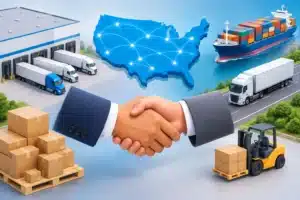
A coordinated regional model offers a practical middle ground. Ecommerce Fulfillment Alliance, for example, connects independent regional operators into a national fulfillment strategy while preserving the responsiveness of local teams. The point is not to add another corporate layer. It is to give brands coordinated coverage without forcing them into an impersonal enterprise model.
Make Technology Serve the Operation
Technology matters, but a polished dashboard will not fix weak warehouse execution. The core question is whether your systems support accurate decisions and fast action.
Your ecommerce platform, order management system, warehouse management system, and carriers need clear rules for order routing, inventory availability, shipping methods, and tracking updates. Test those rules using real scenarios: a partial stockout, a canceled order after release, an address correction, a bundle with components in different locations, and a surge in demand after a promotion.
Pay particular attention to exception visibility. Standard orders should flow with minimal touch. The exceptions are where your team and your fulfillment partner prove their value. You need a defined owner, an escalation path, and reporting that shows why exceptions occur repeatedly.
Avoid overbuilding the stack too early. A complex system with custom rules nobody can maintain creates its own bottleneck. Use the level of automation your order volume and product complexity warrant, then improve it as the operation matures.
Protect Margins as You Improve Delivery Speed
Fast delivery is valuable, but not at any price. The goal is to make ground shipping competitive with premium service by reducing distance between inventory and customers.
Watch the full cost per shipped order, not only the carrier rate. Include pick and pack fees, packaging, storage, receiving, minimums, surcharges, accessorial charges, inventory transfers, and customer-service costs caused by late or inaccurate orders. A low headline fulfillment fee can become expensive quickly if the provider has poor accuracy or pushes most shipments into high zones.
Packaging deserves attention here, especially for dimensional products. A carton that is slightly oversized can create a disproportionate parcel penalty. Test packaging changes carefully. The cheapest box is not always the lowest landed shipping cost, and reducing damage can matter more than saving a few cents on materials.
As volume grows, negotiate from actual data rather than forecasts alone. Carriers and 3PLs respond better when you can show shipment mix, zones, weights, seasonality, and projected growth by region. Transparency gives you leverage and makes it easier to spot pricing that no longer fits the business.
Scale Through Peak Season Before You Need It
The time to learn whether a fulfillment network can scale is not the week before Black Friday. Build a peak plan well ahead of the rush, including inbound cutoffs, labor plans, carrier capacity expectations, packaging supply levels, and customer-service communication.
Ask your provider direct questions. How much volume can each site absorb? What is the receiving turnaround during peak? How are orders prioritized if a carrier pickup is constrained? Who makes decisions after hours when a critical issue appears?
Then run a small stress test where possible. A major promotion, product launch, or marketplace event can reveal gaps in order routing and communication without putting the entire year at risk. The goal is not perfection. It is finding weak points while there is still time to fix them.
Fulfillment should become less mysterious as your brand grows. When you have the right inventory placement, measurable service standards, and partners who answer the phone, national scale stops looking like an enterprise-only privilege. It becomes a practical operating advantage your customers can feel with every delivery.