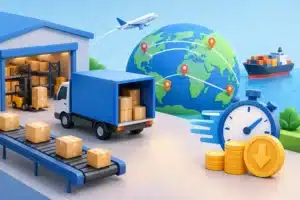
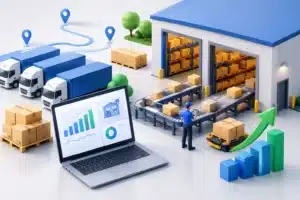
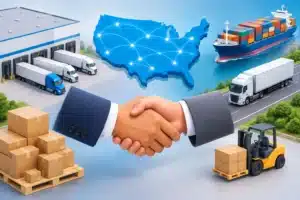
A regional 3PL can run an excellent warehouse, build loyal local customers, and still lose a fast-growing ecommerce opportunity for one simple reason: the brand needs national coverage. Too often, that requirement sends the account directly to a large enterprise provider, even when the enterprise option brings higher fees, weaker support, and less operational accountability. National accounts for regional 3PLs offer a different path – one where independent operators can serve larger brands without pretending to be a single, centralized mega-warehouse.
For ecommerce brands, the question is not whether a regional operator can pick, pack, and ship orders well. Many can do it better than the largest names in fulfillment. The real question is whether several high-performing operators can work as one coordinated national solution. When the answer is yes, brands get lower parcel costs, shorter delivery zones, and people who actually know their business.
Why National Accounts Have Traditionally Favored Enterprise 3PLs
A brand shipping from one warehouse may start to feel the cost of its geography long before its order volume looks enterprise-sized. A West Coast facility serving customers in the Northeast creates more Zone 7 and Zone 8 shipments. A single East Coast facility creates the same problem in reverse. For heavier products, oversized cartons, or brands with high shipping costs relative to product value, those zones can erode margin quickly.
Enterprise 3PLs have historically won this work by selling a familiar story: one contract, many fulfillment centers, national reach. That sounds straightforward, but the operating reality can be less attractive. Brands may be handed to a queue after onboarding, face standardized processes that do not fit their products, and struggle to get a real decision-maker when inventory, carrier performance, or service levels go sideways.
Regional 3PLs have the opposite problem. They often offer better access to leadership, more flexible workflows, and more care on the warehouse floor. But on their own, they may only cover one section of the country. That limitation can keep them out of conversations with brands that need two-day ground delivery across most major markets.
A coordinated network changes the equation. It gives the brand a practical multi-node fulfillment strategy while allowing each regional operator to remain accountable for the work it performs.
What National Accounts for Regional 3PLs Actually Require
Putting multiple warehouses on a sales slide is not a national fulfillment program. A real national account needs commercial alignment, operational standards, and a clear owner of the customer relationship. Without those pieces, the brand is left coordinating multiple vendors, reconciling conflicting answers, and managing the very complexity it hired a 3PL to remove.
A Single Commercial Point of Accountability
The brand should not need separate contracts, invoices, escalation paths, and quarterly reviews for every node. There must be a single team responsible for the overall fulfillment strategy, commercial terms, network performance, and communication.
That does not mean every warehouse must operate identically. In fact, forcing identical processes across independently operated facilities is often where large networks lose their edge. The goal is consistency where the customer feels it: order accuracy, inventory visibility, outbound cutoffs, reporting, exception handling, and service expectations. Local operators can still make smart local decisions on labor, layout, carrier relationships, and day-to-day execution.
Deliberate Inventory Placement
Multi-node fulfillment only works when inventory is placed with intent. Splitting inventory evenly across facilities may look tidy in a spreadsheet, but it can create stockouts, transfers, and stranded units that add cost rather than reducing it.
The right allocation depends on where demand originates, how quickly products replenish, the number of SKUs, product velocity, seasonality, and carton profile. A brand with a small, stable catalog may benefit from two facilities. A brand with a deep assortment or unpredictable demand may need to begin with one primary node and one carefully selected secondary node before expanding further.
The objective is not to have inventory everywhere. It is to position enough inventory close to enough customers that the average shipping zone declines meaningfully. For many national ecommerce brands, two or three well-chosen facilities can support 90% or more two-day ground coverage without paying for air service as a default.
Shared Operating Discipline
A national account falls apart when each facility defines performance differently. One warehouse may count an order as shipped when a label prints, while another counts it only after carrier pickup. One may have a clear process for damaged inbound cartons, while another handles the issue through informal email chains.
Regional partners do not need to become corporate clones, but they do need agreed operating rules. That includes common order cutoffs, receiving requirements, inventory adjustment approvals, reporting cadence, returns handling, escalation procedures, and a defined process for changes to packaging or kitting.
The value of a network is not sameness. It is dependable coordination.
The Financial Case Is About More Than Parcel Rates
Brands often come to the multi-node conversation focused on shipping cost, and rightly so. Reducing average zones can lower ground parcel spend, especially for dimensional products. It can also help brands avoid using expedited service simply to meet a delivery promise that a better inventory location could have met by ground.
But parcel savings are only one side of the decision. Additional facilities bring additional receiving activity, storage minimums, inventory carrying costs, replenishment planning, and possible inter-facility transfers. A brand that distributes inventory too aggressively can lower its average parcel cost while increasing total fulfillment cost.
That is why a serious network recommendation starts with order data, not a map. Review shipment origin and destination history, service levels, weights and dimensions, SKU velocity, order profiles, and projected growth. Then compare the total landed fulfillment cost of one, two, and three nodes.
The answer is not always more warehouses. A brand shipping lightweight products with healthy margins may be better served by one excellent facility. A brand whose orders are heavy, expensive to ship, or concentrated in distant zones may see a fast payback from a second node. The model should follow the economics, not a provider’s desire to fill warehouse space.
What Regional 3PLs Gain Without Giving Up Independence
For regional operators, national accounts can create access to opportunities that would otherwise be out of reach. A strong warehouse in Dallas, Pennsylvania, Southern California, or the Midwest may be ideal for part of a brand’s volume, but not enough to win the entire account alone. Participation in a coordinated network lets that operator compete for its share of national volume while keeping its local identity and operating control.
The trade-off is real. National business requires more discipline around data, customer communication, onboarding, and shared standards. A facility cannot promise a national brand one experience and deliver another when demand spikes. It must be willing to plan jointly, surface problems early, and operate with transparency.
In return, the operator gets a healthier commercial position than a typical subcontractor relationship. Rather than becoming invisible capacity inside a massive enterprise platform, the regional 3PL remains a recognized operating partner with a direct stake in customer performance.
Questions Brands Should Ask Before Choosing a Network
A national network should be evaluated with the same skepticism a brand would apply to any 3PL proposal. Ask who owns the relationship when service fails, how inventory placement decisions are made, and whether each facility has proven experience with your product profile.
Also ask for clarity on data and escalation. Can the brand see inventory by location? Who responds when an order is short-shipped or a carrier misses a pickup? What happens if one node misses service levels during peak season? Vague answers about “network capabilities” are not enough. The operating model should be specific before inventory moves.
Finally, evaluate whether the proposed footprint matches your actual customers. A map with many pins can be impressive, but it does not automatically reduce zones. The best network is the one that places inventory where your demand is, maintains service quality, and gives your team a clear line to people who can solve problems.
Ecommerce Fulfillment Alliance was built around this principle: national fulfillment should not require a brand to accept enterprise indifference. The right regional partners, coordinated around a disciplined operating model, can give growing brands the coverage they need and the service they have been missing.
Before committing to a national fulfillment contract, put your shipment history next to the proposed node strategy. If the footprint cannot clearly improve zones, delivery speed, and accountability at the same time, it is not yet the right network.