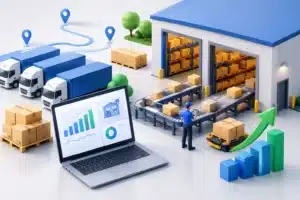
A brand can be doing $10 million in annual revenue, shipping thousands of orders every month, and still be paying a hidden growth tax: too many packages leaving from one warehouse. This shipping zone savings example shows how a practical two-node fulfillment model can reduce parcel spend by roughly $240,000 per year while getting more customers their orders in two days.
The numbers are illustrative, but the problem is not. For ecommerce brands shipping nationally from a single location, zones 6, 7, and 8 are often where margin gets squeezed, delivery promises slip, and customer service tickets pile up. The answer is not always a giant enterprise 3PL contract. Often, it is a better inventory placement decision.
The shipping zone savings example: one warehouse vs. two
Consider a US-based ecommerce brand with $12 million in annual sales. It ships 180,000 parcels per year, or about 15,000 orders per month. Its products are moderately sized and weigh an average of four pounds packed. The brand currently fulfills every order from a warehouse in Southern California.
Its customer base is spread across the country: 35% in the West, 30% in the Midwest, 25% in the East, and 10% in the South. That distribution is common for a growing brand that has successfully acquired customers outside its original region but has not yet updated its fulfillment footprint.
From California, Western orders move in lower zones. But orders headed to Illinois, Texas, Florida, New York, and the Northeast routinely travel across zones 6 through 8. Those are expensive shipments, especially once dimensional weight, residential surcharges, and annual carrier rate increases enter the picture.
Assume the brand’s blended parcel cost from its single California warehouse looks like this:
| Destination zone range | Share of orders | Average shipping cost | | — | —: | —: | | Zones 2-4 | 40% | $8.40 | | Zones 5-6 | 30% | $10.90 | | Zones 7-8 | 30% | $14.60 |
Its weighted average parcel cost is $10.70. Across 180,000 annual shipments, that produces annual parcel spend of $1,926,000.
Now the brand adds a second fulfillment location in the Midwest, with inventory split between California and a centrally located warehouse. The goal is not to stock every SKU equally in both buildings on day one. The goal is to place the fastest-moving inventory close to the largest concentration of demand, then route each order from the node that produces the best combination of cost, transit time, and available inventory.
With a sensible inventory allocation, the shipping profile could shift to 70% of orders in zones 2 through 4, 22% in zones 5 through 6, and just 8% in zones 7 through 8. The new blended shipping cost might look like this:
| Destination zone range | Share of orders | Average shipping cost | | — | —: | —: | | Zones 2-4 | 70% | $8.40 | | Zones 5-6 | 22% | $10.90 | | Zones 7-8 | 8% | $14.60 |
That drops the weighted average parcel cost to about $9.37 per order. At 180,000 shipments, annual parcel spend falls to approximately $1,686,600.
The gross parcel savings: about $239,400 per year.
That is the headline number. It is also where many fulfillment sales pitches stop. They should not.
Savings are real only after added operating costs
A second node adds expense and operational complexity. There is more inbound freight to manage, more inventory to allocate, potentially more safety stock, and another warehouse relationship to oversee. A credible shipping zone strategy has to account for those costs rather than pretending national distribution is free.
In this example, assume the second facility creates $75,000 in annual incremental expense through additional inbound handling, inventory balancing, and modest duplicate-stock requirements. The brand may also incur one-time setup costs for onboarding, systems integration, and inventory transfer.
Even after the recurring $75,000, the brand retains roughly $164,400 in annual net savings. More importantly, it has changed the economics of every new order it acquires in the Midwest and East. As order volume grows, the fixed complexity of the second node is spread across more shipments, making the model more attractive.
This is why zone reduction is not just a carrier-negotiation tactic. Carrier discounts matter, but a discount applied to a zone 8 shipment is still a discount on an expensive shipment. Moving that package to zone 3 changes the underlying cost before the carrier agreement is even applied.
Delivery speed creates a second return
The parcel savings alone make the case compelling. But delivery performance is usually the more visible customer benefit.
Under the one-node California model, West Coast customers may receive orders in one or two days by ground. Customers in the Midwest may wait three or four days. East Coast customers can face five or more days, particularly during seasonal congestion or when a package misses an outbound cutoff.
With inventory in California and the Midwest, the brand can reach a much larger share of customers with two-day ground service. Depending on the exact node locations and customer distribution, 90% or more two-day ground coverage is achievable without paying for air service on routine orders.
That distinction matters. Many brands respond to slow ground delivery by subsidizing expedited shipping or offering free two-day delivery they cannot profitably support. A distributed fulfillment model aims to make two-day delivery the natural outcome of ground shipping, not an expensive exception.
Faster delivery can also reduce “Where is my order?” contacts, decrease cancellation requests after purchase, and give the brand a more credible delivery promise at checkout. Those benefits are harder to model precisely, but operations leaders see them in support queues and repeat-purchase behavior.
When a second node does not make sense yet
Not every brand should add warehouses. If annual order volume is low, customer demand is tightly concentrated in one region, or the catalog has a large number of slow-moving SKUs, splitting inventory can cost more than it saves.
A brand with 20,000 orders per year, for example, may not have enough parcel volume to overcome duplicate receiving, storage, and inventory management costs. The same goes for a catalog where every order contains a different mix of hundreds of low-velocity products. In that case, a single central node or a carefully chosen primary warehouse may be the smarter move.
Product characteristics matter too. Lightweight apparel can generate savings from zone reduction, but the difference may be less dramatic than it is for bulky, dimensional, or heavier products. A seven-pound home goods package, a boxed supplement bundle, or an oversized accessory can become expensive quickly as zones increase. These brands often see the strongest financial case for regional fulfillment.
The question is not, “Should we have more warehouses?” The question is, “At what shipment volume, order profile, and geographic demand mix does another node produce a positive return?”
Build the model from your real order data
A useful analysis starts with 12 months of shipment history, not a generic zone map. Pull each order’s destination ZIP code, package weight and dimensions, carrier service, actual freight charge, and order value. Then group the data by zone, state, and region.
Look closely at three things: the share of volume traveling zones 6 through 8, the actual cost difference between short- and long-zone orders, and the locations of your fastest-moving SKUs. Those inputs reveal whether a second node will materially change your shipping profile.
Then model inventory placement conservatively. Do not assume perfect stock availability or that every order will ship from the ideal warehouse. Account for stockouts, split shipments, replenishment frequency, inbound freight, storage, pick fees, and the cost of holding incremental inventory. If the savings remain compelling after those assumptions, the opportunity is probably real.
This is also where a coordinated regional network can outperform a monolithic enterprise provider. The right network gives a brand national reach while keeping each warehouse accountable for its local operation. You get a designed fulfillment footprint, not a generic promise that bigger is better.
For a growing brand, the best time to evaluate zones is before parcel spend becomes accepted as unavoidable. Map where customers live, price the cost of distance honestly, and test whether a second node changes the math. If it does, every order that ships closer to its destination becomes a small, repeatable improvement to margin and customer experience.