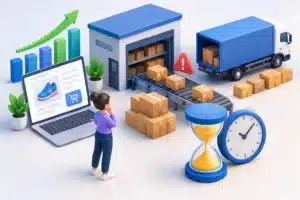
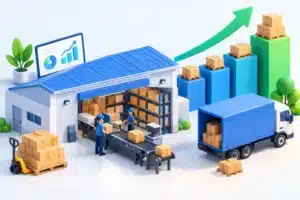
A brand shipping from one warehouse in Southern California can look efficient on a spreadsheet and still lose money on every East Coast order. The issue is not simply warehouse capacity. It is the cost of carrying inventory, the parcel zones customers sit in, and how quickly someone can solve a problem when an inbound arrives short or a promotion spikes demand. That is where the owned versus partner warehouses decision becomes a real growth decision, not a real estate decision.
For ecommerce brands in the $2M-$50M range, the right answer is rarely about owning the most square footage. It is about building a fulfillment model that improves delivery performance without locking the business into enterprise overhead, rigid contracts, and distant support teams.
What Each Warehouse Model Actually Means
An owned warehouse model means one company controls the facilities, labor, systems, operating procedures, and often the leases themselves. Large 3PLs typically build their networks this way. A brand may also operate its own warehouse, although that is a very different commitment from outsourcing to a national provider with owned sites.
A partner warehouse model connects independent regional 3PLs through common commercial standards, technology expectations, account management, and network planning. Each operator retains local ownership and operational responsibility, while the brand gains access to multiple fulfillment nodes under a coordinated strategy.
Neither model is automatically superior. The useful question is whether the model fits your order volume, product profile, customer geography, and tolerance for fixed cost.
Owned Versus Partner Warehouses: The Real Trade-Offs
Enterprise providers often present owned facilities as proof of control. There is truth in that. A single owner can impose standard processes, make network-wide system changes, and move volume between facilities without negotiating with separate operators.
But control on paper is not the same as accountability in practice. When a brand is one account among thousands in a large owned network, escalation can still move slowly. The warehouse may be owned by the provider, yet the people handling your account may have limited authority to fix an issue, adjust a process, or make an exception when the situation calls for one.
Partner networks trade centralized ownership for local accountability. The regional operator is usually closer to the floor, the labor plan, the receiving dock, and the customer. That can mean faster decisions and better communication, particularly for brands with kitting requirements, seasonal swings, oversized products, or special handling needs.
The risk is inconsistency. A loose collection of warehouses is not a network. Without shared onboarding standards, data visibility, service-level expectations, and active coordination, a brand can end up managing several separate 3PL relationships instead of one fulfillment strategy. The partner model only works when there is real network discipline behind it.
Cost: Fixed Infrastructure Versus Flexible Capacity
Owned networks carry substantial fixed costs. Buildings, automation, management layers, technology investments, and nationwide sales infrastructure all need to be paid for. Those costs are not inherently bad, especially at enormous scale. But they often show up in minimums, long commitments, complex fee schedules, or charges that make sense for high-volume enterprise accounts but not for a growing brand.
A regional partner model can be more flexible because it uses capacity where it already exists. Instead of paying for a provider to maintain a massive footprint regardless of your needs, you place inventory in the markets that reduce your shipping zones and support your demand.
That does not mean partner warehouses are always cheaper line by line. A highly automated owned operation may produce a lower pick fee for a simple, fast-moving SKU profile. But pick fees are a poor way to judge the total cost of fulfillment. Brands should look at landed fulfillment cost: storage, receiving, pick and pack, packaging, accessorial charges, outbound parcel spend, and the customer-service cost of late deliveries or shipping damage.
For many national brands, parcel spend is the largest opportunity. Moving inventory closer to demand can reduce average zones, limit expensive long-haul shipments, and create 2-day ground coverage for the majority of customers without paying for premium air service. That saving can outweigh a modest difference in warehouse handling rates.
Speed Depends on Inventory Placement, Not a Logo on the Building
A national logo does not guarantee national performance. If inventory is concentrated in the wrong places, orders still travel across the country. A single owned network can have the same problem as a single independent warehouse: too much inventory in one location and too many customers far away from it.
The better approach starts with order data. Where are customers located? Which SKUs drive most shipments? Are there regional demand patterns? How heavy or dimensional are the orders? A lightweight apparel brand and a seller of bulky home goods should not make the same node decision.
From there, a brand can determine whether two, three, or more strategically placed locations will materially reduce zones. For many mid-market ecommerce companies, a small number of regional nodes can deliver 90%+ 2-day ground coverage. Adding facilities beyond that point may create more inventory fragmentation and replenishment work than delivery value.
This is one area where a coordinated partner network has a practical advantage. It can add coverage in the regions that matter without forcing a brand into a standardized national footprint it does not need.
Service Is Where the Models Separate Fast
When fulfillment is running well, every provider looks competent. The test comes when it is not. A container misses its appointment. A marketplace routing guide changes. A product launch requires a last-minute kitting update. A carrier exception starts affecting thousands of orders.
In a large owned network, support is often tiered. The warehouse team, account manager, implementation group, and executive escalation path may all be separate. That structure can work, but it can also turn an urgent operational issue into a ticket queue.
Regional warehouse partners are often more accessible because leadership is closer to the operation. That does not excuse poor systems or informal communication. It means the person who can actually change a shift plan or inspect an inbound may be reachable sooner.
Brands should ask direct questions before choosing either model. Who owns the relationship after implementation? Who can authorize an operational change? What happens if shipping performance slips? Will you receive node-level reporting, or only a network-wide dashboard? Clear answers matter more than polished sales language.
When an Owned Network May Be the Better Fit
An owned network can make sense for brands that need highly uniform processes across a very large number of locations, have exceptional volume concentration, or require specialized automation that a regional operator cannot support. It can also be a fit when a company values one provider with total facility control and is comfortable with more standardized operating rules.
The key is verifying that the promised scale produces better outcomes for your business. If your products are simple, your volumes are high and predictable, and the provider can prove lower total cost and reliable service, an owned network may be the right call.
When Partner Warehouses Create a Better Path
Partner warehouses are often a stronger choice for growing brands that need national reach but do not want to be treated like a small account inside a giant enterprise machine. They work especially well when product requirements vary, demand is changing, parcel costs are rising, or executive access matters.
The model is not about assembling the cheapest warehouse options in each region. It is about selecting capable operators, creating consistent expectations, and managing inventory as one national program. Ecommerce Fulfillment Alliance was built around that premise: regional service quality can coexist with coordinated national coverage when the network is designed to be accountable.
Choose the Model Based on Outcomes
Do not choose fulfillment based on whether a provider owns the roof. Choose based on what happens after inventory arrives: your average shipping zone, total fulfillment cost, on-time ship rate, damage rate, 2-day ground reach, and the quality of response when something goes wrong.
Ask each prospective provider to model your actual order history, not a generic shipping profile. Make them show how inventory would be placed, what it would cost to replenish nodes, and where service responsibility sits. The right warehouse model should make your operation easier to run while giving customers a faster, more dependable delivery experience.
A better network is not necessarily the biggest one. It is the one that puts inventory in the right places and puts accountable people within reach when your brand needs them.