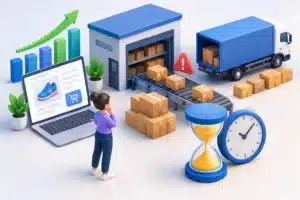
A customer sees one promise: ordered today, delivered by Friday. Your operations team sees a chain of inventory receipts, order imports, pick paths, packing stations, carrier cutoffs, and tracking events. That gap is why the question, what causes fulfillment delays, rarely has one simple answer. Orders usually do not fail because a warehouse suddenly stops working. They fail because small breakdowns stack up until the promised ship date is no longer realistic.
For growing ecommerce brands, the cost is bigger than a few late packages. Delays create support tickets, refund requests, bad reviews, canceled subscriptions, and a loss of confidence that is hard to measure in a weekly operations report. The right response is not just pushing a 3PL to work faster. It is finding the actual constraint and fixing the system around it.
What causes fulfillment delays most often?
A fulfillment delay occurs when an order misses its expected processing or ship window. That is different from a package delayed in carrier transit, though customers understandably treat both as the same problem. If the order has not received a carrier acceptance scan, the issue is usually upstream. If it was scanned on time but sits in a carrier network, the cause may be a weather event, service disruption, or an unrealistic delivery promise.
The most common causes fall into four connected areas: inventory control, order data, warehouse capacity, and network design. A capable operator can manage one difficult area. Trouble starts when several are weak at once.
Inventory that exists on paper but not on the shelf
Inventory accuracy is the foundation of on-time fulfillment. If your storefront says an item is available but the warehouse cannot locate it, the order enters an exception queue. Someone has to research the SKU, check alternate locations, confirm whether units were damaged or miscounted, and decide whether to split, substitute, or cancel the order.
This happens frequently after rushed inbound receipts, poor cycle-count discipline, unannounced purchase order changes, and bundles that are assembled incorrectly. It also happens when a brand sells through multiple channels but does not maintain clean inventory synchronization. A marketplace order, wholesale allocation, and direct-to-consumer promotion can all compete for the same units.
The fix is not simply carrying more safety stock. Excess inventory can tie up cash and still fail to solve a location-level accuracy problem. Brands need clear receiving rules, routine cycle counts for fast movers, disciplined quarantine processes for damaged goods, and inventory data that updates quickly across every selling channel.
Orders that arrive late, incomplete, or on hold
An order can be paid and confirmed on your website yet still be unavailable for picking. Integration failures, delayed order imports, address-validation errors, fraud-review rules, tax issues, and missing shipping-method mappings can hold orders before the warehouse ever sees them.
These problems become more visible during growth spurts. A new subscription app, marketplace connection, bundle offer, or promotional code may introduce order logic that was never tested at real volume. The warehouse receives exceptions instead of clean, pickable orders. Its team then spends time interpreting rules that should have been handled automatically.
Watch the time between customer order confirmation and warehouse release. If that gap is inconsistent, a labor problem may not be your problem at all. Ask for a report showing orders received, orders released, orders held, and the reason each hold was created. Large providers sometimes bury this visibility behind a support queue. That is not acceptable when customer delivery promises are on the line.
Capacity that looks fine until volume spikes
Most fulfillment operations can process an average Tuesday. Peak days are what reveal whether capacity planning is real. A flash sale, influencer mention, holiday promotion, or delayed inbound container can turn manageable volume into a backlog within hours.
Labor is often part of the issue, but it is not the whole issue. Warehouse throughput depends on staffing, trained backup labor, workstation availability, pick-path design, packaging supplies, equipment uptime, and the number of orders requiring special handling. A single SKU that needs kitting, inserts, serial-number capture, or a nonstandard carton may take far longer than a standard pick-and-pack order.
This is where a low advertised pick fee can become expensive. Some operators price for simple orders and struggle when product complexity rises. Others accept more volume than their building, systems, or management team can responsibly handle. When service drops, the brand gets a generic explanation about peak season rather than a recovery plan with dates and owners.
A good fulfillment partner should define normal service levels, peak capacity, cutoff times, and escalation procedures before the sale happens. If a promotion will exceed forecasted daily volume, the operator needs notice. In return, it should tell you what it can realistically process, not what sounds reassuring in a sales call.
Poor warehouse layout and SKU complexity
Not every slow operation is understaffed. Sometimes the physical setup is working against the team. Fast-moving products stored far from packing stations, oversized goods mixed into standard pick zones, and too many similar-looking SKUs all increase travel time and picking errors.
Brands with heavier, dimensional, fragile, or multi-piece products face a sharper version of this problem. Their orders may need specific cartons, dunnage, labels, or quality checks. Those requirements are manageable, but only if the warehouse designs the process around them. Treating complex products like generic small-parcel apparel is how delays and damage claims become routine.
Ask whether your top sellers are slotted based on velocity, whether kits are preassembled or built to order, and how exceptions are physically separated from normal work. These are operational details, but they determine whether a warehouse stays in control as order volume grows.
Carrier cutoffs and missed handoffs
An order marked as shipped is not necessarily moving. Some systems generate a label and tracking number before the package has been collected by the carrier. If cartons miss the daily pickup, they may wait until the next business day, even though the customer received a shipping notification.
Late pick completion, insufficient dock staffing, trailer delays, incorrect manifesting, and carrier capacity constraints can all create missed handoffs. The problem is especially painful when a warehouse has an early parcel cutoff but markets a late order cutoff without enough operational buffer.
Measure carrier acceptance scans, not just labels created. A healthy operation should know what percentage of packages receive an acceptance scan on the same day their label is generated. That metric exposes the difference between administrative shipping activity and packages actually entering the carrier network.
The network design problem many brands miss
A brand can have an efficient warehouse and still disappoint customers because inventory sits too far from demand. Shipping every order from one coast creates long zones for the other half of the country. Higher parcel costs and longer transit windows follow. During carrier disruptions, there is little room to recover.
This is not always a reason to open multiple facilities. Splitting inventory adds receiving work, transfer planning, safety-stock requirements, and more complex forecasting. For lower order volume or concentrated demand, one well-run location may be the right choice.
But once a brand ships nationally at meaningful scale, a multi-node strategy can remove a major source of perceived fulfillment delays. Positioning inventory across regional facilities puts more customers within 2-day ground reach, reduces dependence on air upgrades, and gives operations another option when one region faces weather or capacity pressure. The goal is not to add warehouses for the sake of scale. It is to place inventory where it improves the customer promise and the parcel economics.
How to find the real bottleneck
Do not start with a vague complaint that orders are late. Trace a sample of delayed orders through the full timeline: order placed, order released, pick started, packed, label created, carrier accepted, and delivered. Patterns will appear quickly.
If orders are released late, investigate integrations and holds. If picking starts late, look at labor planning, inventory availability, and queue management. If packed orders miss acceptance scans, examine dock operations and carrier pickup performance. If packages leave on time but arrive late, review transit maps, service selection, and where inventory is positioned.
Use a small set of operating metrics consistently: same-day ship rate for orders received before cutoff, backlog aging, inventory accuracy, order-hold rate, carrier acceptance timing, and delivery performance by zone. A monthly scorecard is useful, but daily visibility matters when a promotion or inbound issue starts to create a backlog.
The brands that recover fastest also establish a clear escalation path. Your operator should identify the issue, quantify the affected orders, explain the cause in plain language, and state what happens next. Silence, ticket deflection, and vague status updates are not operational management.
Fulfillment delays are rarely solved by demanding that a warehouse move faster. They are solved by building an accountable operation where inventory, systems, labor, carriers, and facility locations support the same delivery promise. When those pieces are aligned, growth does not have to mean more late-order apologies.