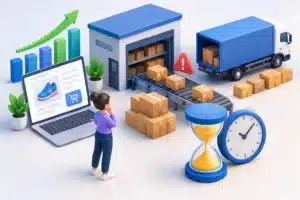
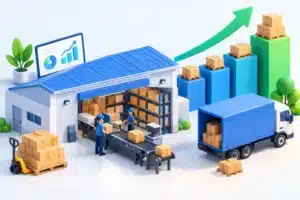
A fulfillment setup can look perfectly acceptable at 2,000 orders a month and become a margin problem at 10,000. Shipping costs creep up, receiving backs up, customer tickets rise, and the same 3PL that once felt responsive starts routing every issue through a support queue. This fulfillment scalability guide is for brands that need to grow order volume without accepting slower delivery, higher parcel spend, or an enterprise contract that makes every change difficult.
The central question is not whether your warehouse can process more orders. Most can, at least for a while. The real question is whether your fulfillment model can absorb more volume while keeping cost per order, delivery speed, inventory accuracy, and accountability under control.
What Fulfillment Scalability Actually Means
Scalable fulfillment is the ability to increase volume without creating a proportional increase in cost, complexity, or customer frustration. That includes peak periods, new sales channels, product launches, promotions, and the occasional problem that no forecast caught.
A single warehouse may scale operationally by adding labor, shifts, racks, and packing stations. But it does not necessarily scale geographically. If most of your customers are on the opposite side of the country, higher order volume can mean more Zone 7 and Zone 8 shipments, more expensive packages, and delivery promises that get harder to keep.
This is where many mid-market brands get pushed toward a large national 3PL. The pitch is familiar: more facilities, more technology, more scale. The trade-off is often rigid onboarding, minimums, layered account management, and a support model where your brand is one ticket among thousands. Bigger infrastructure is useful. Being treated like a small account inside it is not.
A better model separates national reach from enterprise bureaucracy. Regional fulfillment nodes can place inventory closer to demand while preserving direct operational relationships with the people handling your product.
Start With the Numbers That Expose the Problem
Before adding a warehouse or changing providers, establish a baseline. Decisions made from total shipping spend alone tend to miss the actual source of the problem.
Look at your average shipping zone, average cost per shipment, percent of orders delivered within two days by ground service, and parcel cost by product type. Then compare those numbers across customer regions. A brand shipping heavy home goods from one East Coast location may find that the West Coast is consuming an outsized share of its parcel budget. A beauty brand with small, light parcels may find that speed, rather than shipping expense, is the bigger opportunity.
You should also track receiving turnaround, pick accuracy, order-to-ship time, inventory variance, and the time required to resolve an exception. These operational measures matter because growth exposes weak handoffs. A warehouse that ships quickly but takes two weeks to receive a container will eventually create stockouts and frustrated customers.
Four questions usually make the next step clearer:
- Where are your orders actually going, by region and ZIP code concentration?
- Which SKUs create the highest fulfillment or parcel cost?
- Are delivery complaints caused by warehouse processing, carrier transit, or poor inventory placement?
- Can your current partner give you a straight answer and a corrective plan when performance slips?
If you cannot get clean data or timely answers, that is not a reporting inconvenience. It is a scalability risk.
Add Nodes When the Economics Justify It
A second fulfillment location is not automatically the right move. Splitting inventory adds complexity. You will have more replenishment decisions, more cycle counts, more inbound routing rules, and potentially more inventory sitting in safety stock. For a concentrated customer base or low-volume business, the added operating cost can outweigh parcel savings.
The case changes when your demand is national, your products are dimensional or heavy, and a meaningful percentage of orders travel long distances. Reducing average shipping zones can lower parcel expense while bringing two-day ground delivery within reach for most customers. For many brands, two or three well-positioned nodes do more than a single giant facility ever could.
The goal is not to put inventory everywhere. It is to position enough inventory in the right regions to materially improve cost and transit time. That requires order history, product velocity, inbound freight economics, and a realistic view of what each facility can handle.
A common mistake is distributing every SKU equally. Fast-moving core items should be available where demand supports them. Slow sellers, oversized products, seasonal items, and bundle components may belong in fewer locations. The right allocation is rarely static, either. It should be revisited as sales mix and regional demand shift.
Build Capacity Beyond Warehouse Square Footage
Warehouse capacity is more than open pallet positions. A facility can have space and still fail during growth because it lacks labor planning, receiving discipline, system controls, or packaging capacity.
Ask prospective and current fulfillment partners how they manage daily order cutoffs, peak season staffing, late carrier pickups, damaged inventory, returns surges, and inbound appointments. Ask who owns the answer when a shipment misses SLA. Vague assurances about capacity are not enough. You want operating specifics.
Technology deserves the same scrutiny. Your warehouse management system and ecommerce integrations should prevent oversells, route orders to the appropriate node, hold problematic orders for review, and provide usable inventory visibility. But technology does not replace accountable people. An impressive dashboard will not fix a mislabeled pallet, a delayed container, or a recurring pack-out error unless someone is empowered to act quickly.
For brands with complex products, confirm the operational details early. Kitting, inserts, lot tracking, serial numbers, custom packaging, retail compliance, and returns inspection all need defined workflows. Enterprise providers often handle these services, but may charge heavily or treat exceptions as custom projects. A scalable partner should be able to explain the process, cost, and turnaround without hiding behind a statement of work.
Protect Service as Volume Grows
Customer experience is often where fulfillment failures become visible. A late order does not read as a carrier issue or a warehouse issue to the customer. It reads as your brand failing to deliver.
Set practical service levels for order release, same-day shipping, inventory accuracy, and exception response. Then make sure those standards are measured by location, not only as a network average. A blended network score can hide a struggling facility until customers in that region start complaining.
Executive accessibility matters here. When your business is moving quickly, you should not need to escalate through three account layers to get an answer about a missed pickup or an inventory discrepancy. The right relationship has clear operational contacts, regular reviews, and decision-makers who understand that protecting your customer experience is the job.
Ecommerce Fulfillment Alliance is built around this premise: national fulfillment can be coordinated through strong regional operators without forcing a growing brand into an impersonal enterprise model. The network approach works when every node follows shared standards while retaining the local accountability that large centralized providers often lose.
Use a Deliberate Transition Plan
The biggest fulfillment changes fail when brands treat them as a simple inventory move. A new node or provider affects inbound routing, SKU masters, integrations, packaging supplies, customer communications, and forecasting. If the cutover is rushed, the savings you expected can disappear into expedites, duplicate shipments, and preventable support work.
Start with a phased launch when possible. Move a defined region, sales channel, or group of SKUs first. Test order routing, inventory feeds, labels, packing requirements, and return flows before moving the full business. Keep a clear owner for each workstream, including your own internal team. Outsourcing fulfillment does not outsource the need for strong implementation oversight.
The transition plan should also define what success looks like after 30, 60, and 90 days. Measure parcel savings, transit time, order accuracy, receiving speed, and exception rates against the baseline. If performance is off, address the cause early. Waiting for a quarterly business review to discuss recurring operational misses is how small problems become expensive ones.
Know When Your Model Has Hit Its Limit
There is no universal revenue threshold for multi-node fulfillment. Some $3 million brands need it because their products are heavy and their customers are national. Some $20 million brands can remain in one location because their demand is regionally concentrated or their products ship cheaply.
The warning signs are more useful than a revenue number: parcel costs rising faster than sales, too many long-zone shipments, growing dependence on air service, recurring capacity constraints, slow issue resolution, and a provider that cannot flex around your business. Those problems rarely improve on their own as volume increases.
Growth should give your brand more leverage, not less. Build a fulfillment model that puts inventory near demand, makes costs visible, and keeps real operators accountable. When the next spike in orders arrives, you should be planning the next move, not wondering whether your warehouse can keep up.