A customer in Phoenix places an order at 2:15 p.m. The same SKU is available in Nevada, Texas, and New Jersey. How does order routing work? The system should select the location that can fulfill the order accurately, meet the promised delivery date, and avoid paying to ship a lightweight box across five zones. That decision sounds simple. At scale, it is where fulfillment strategy either protects margin or quietly drains it.
For growing ecommerce brands, order routing is not just a software setting. It is the operating logic behind shipping cost, delivery speed, inventory availability, and the customer experience after checkout.
How does order routing work across a fulfillment network?
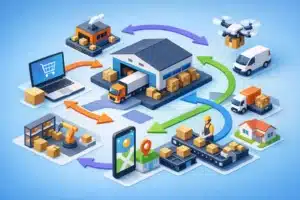
Order routing is the process of assigning an incoming order to the best fulfillment location before it is picked, packed, and handed to a carrier. In a multi-node network, an order management system receives the order from your ecommerce platform, reviews available inventory across warehouses, and applies a set of routing rules.
The selected warehouse then receives the order in its warehouse management system. Its team picks the item, confirms the shipment, prints the label, and sends tracking information back through the technology stack. To the customer, it looks like one order from one brand. Behind the scenes, the system has made a series of decisions in seconds.
The goal is usually not to choose the geographically closest warehouse in every case. The best route depends on what is actually in stock, the shipping service required, warehouse cutoff times, parcel rates, and whether the order can ship complete from one location.
A good routing engine balances these factors rather than blindly following one rule. A cheap route that misses a delivery promise is a bad route. So is a fast route that turns every order into an unnecessarily expensive air shipment.
The rules that decide where an order ships from
Most routing decisions begin with inventory. If an item is stocked only in one warehouse, the order has no real choice. But once the same SKU is positioned in multiple locations, the network can make a smarter call.
First, it checks inventory that is truly available, not merely shown as on-hand. Inventory may be reserved for another order, held for quality review, or already committed to a marketplace channel. Accurate, near-real-time inventory data is the foundation. Without it, routing software can direct an order to a facility that cannot ship it, creating avoidable cancellations, delays, or split shipments.
Next, the system considers the destination and service promise. A customer in Georgia may be reachable by ground from a Southeast facility in one or two days, while an order from a West Coast node could take four or five. If the brand promises two-day delivery, the closer facility has a clear advantage.
Parcel cost matters as well. Carriers price most residential shipments based on zone, weight, dimensions, and service level. Reducing the average distance a package travels can lower transportation spend, particularly for heavy or dimensional products that get punished by long-zone shipping. This is why a two- or three-node strategy can produce meaningful savings even before a brand has enterprise-level volume.
The routing logic also needs to account for operational reality: a warehouse’s daily cutoff, current capacity, carrier pickup schedule, and special handling requirements. A location may be technically closest but unable to ship same day after its cutoff. Another site may have the product kitted, labeled, or ready for a subscription program that requires a specific packing process.
Routing is different from inventory allocation
These terms often get lumped together, but they solve different problems. Inventory allocation decides where inventory should sit before the order arrives. Order routing decides which location should fulfill an order after it arrives.
Allocation is the strategic decision. A brand might send 40% of a fast-moving SKU to the West, 35% to the Central region, and 25% to the East based on demand history. Routing is the tactical decision that follows: when an order comes in, which available unit should ship?
Weak allocation creates weak routing outcomes. If most inventory stays in one coastal warehouse, no routing rule can consistently create fast, low-cost delivery for customers across the country. The network needs enough inventory coverage to give the system legitimate choices.
That does not mean every SKU belongs in every building. Duplicating slow-moving products across too many nodes can tie up cash, increase replenishment work, and create stranded inventory. The right answer depends on item velocity, margin, size, demand concentration, and replenishment lead times. High-velocity, high-cost-to-ship items are often the strongest candidates for distributed inventory.
What good order routing looks like in practice
Consider a brand with facilities in Nevada, Texas, and Pennsylvania. A customer in Chicago orders two products. Both are available in Texas, but only one is available in Pennsylvania. If the system routes the order to Pennsylvania because it is slightly closer, it creates two shipments. That can mean two parcel charges, two cartons, two tracking emails, and a more confusing delivery experience.
A smarter rule may favor Texas because it can ship the complete order in one box with two-day ground service. The brand may pay a little more on transit than it would for one item from Pennsylvania, but it avoids the larger cost and customer-service burden of a split order.
Now change the situation. The Texas site is out of stock on one item, while Pennsylvania can ship that item within the promised timeframe and Nevada can ship the other at a favorable rate. The system may need to split the order. That is not automatically a failure. It is a controlled trade-off, provided the brand understands when split shipments are allowed and communicates clearly with the customer.
Effective routing policies define these trade-offs upfront. They establish when to prioritize a complete order, when to prioritize delivery speed, when a backup location can be used, and when an order should be held for review rather than sent through an expensive exception path.
The metrics that reveal whether routing is working
Brands should not accept vague claims that their fulfillment provider has “smart” routing. Ask for the operating metrics behind it. Four measures tell a clearer story:
- Average shipping zone, which indicates how far packages travel on average.
- Percentage of orders delivered by ground in one or two days, which shows whether the network supports the customer promise.
- Split-shipment rate, which identifies avoidable parcel and packaging costs.
- Order accuracy and on-time shipment rate, because lower freight spend means little if fulfillment execution suffers.
Also look at cost by order profile, not just blended shipping cost. A network may perform well for small apparel parcels yet be a poor fit for oversized, fragile, hazmat, or multi-item orders. Brands with dimensional products need routing and warehouse placement designed around their actual freight exposure, not a generic average.
Where enterprise fulfillment models often fall short
Large fulfillment providers can have broad geographic footprints, but footprint alone does not create good routing. The problem often appears in the details: limited visibility into routing rules, inflexible inventory policies, slow exception handling, and support teams that cannot make a practical decision when an order falls outside the standard flow.
A brand may be told it has national coverage while still watching orders travel unnecessary distances because inventory was positioned poorly or because the platform follows a rigid default rule. When questions arise, the answer can disappear into a ticket queue.
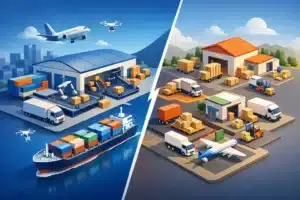
A coordinated regional model takes a different approach. It combines multiple local operators into one national fulfillment strategy while preserving the hands-on accountability that growing brands need. Ecommerce Fulfillment Alliance is built around that model: regional warehouse capability coordinated around a brand’s shipping zones, service goals, and inventory plan rather than forcing the brand into an enterprise template.
The technology matters, but people still matter when routing exceptions occur. Inventory discrepancies, weather disruptions, carrier constraints, and sudden demand spikes require someone who understands the account and can act quickly. Automation should handle routine decisions. It should not become an excuse for unresponsive service.
How to improve routing before adding more warehouses
Adding nodes can improve delivery speed, but it also adds complexity. Before opening another fulfillment location, examine where orders are actually going, which SKUs drive the most parcel spend, and how often customers fall outside your two-day ground coverage.
Many brands discover they do not need five warehouses. They need better inventory placement across two or three well-chosen regions, routing rules that protect complete orders, and a fulfillment partner willing to show the data. The right network is the one that reduces zones without turning inventory management into a mess.
Start with the customer map, not the warehouse map. Where demand is concentrated, where parcels cost the most to ship, and where delivery promises are missed will tell you far more than a provider’s facility count. Better routing begins when every order is treated as a margin decision and a customer promise at the same time.
The useful question is not whether your orders can be routed automatically. It is whether the rules behind that automation reflect how your business actually wins: lower landed cost, faster ground delivery, and fewer customers wondering why one order arrived in three boxes.