A brand shipping 10,000 orders a month does not need more logistics theater. It needs lower parcel costs, reliable delivery promises, and someone who answers when a launch goes sideways. ShipBob versus regional warehouses is not simply a question of warehouse footprint. It is a decision about how much control, accountability, and operational flexibility your business keeps as volume grows.
For a fast-growing ecommerce company, both models can provide inventory storage, pick-and-pack services, and parcel shipping. The real differences appear in the details: how orders are routed, who owns the relationship when something fails, how pricing responds to dimensional weight, and whether your fulfillment setup can change with your business.
ShipBob Versus Regional Warehouses: The Core Difference
ShipBob is a large, technology-led fulfillment provider with a standardized operating model and a broad network of facilities. Its appeal is straightforward: a recognizable platform, packaged integrations, and a path for brands that want to get fulfillment moving quickly without building a complicated provider network themselves.
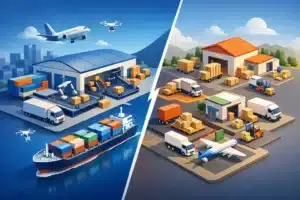
Regional warehouses are independent 3PL operators concentrated in specific parts of the country. On their own, a regional provider may be an excellent fit for a brand whose customers are concentrated nearby. Connected through a coordinated multi-node network, regional operators can also support national distribution while retaining the hands-on service that often disappears inside a large enterprise 3PL.
That distinction matters. With a large national provider, your account may move through standardized workflows designed to serve thousands of merchants. With the right regional warehouse partner, the operating team handling your product is usually closer to the decision-makers. Exceptions, kitting needs, packaging changes, carrier issues, and inventory questions tend to reach people who can act rather than a ticket queue.
Neither model is automatically better. ShipBob can make sense for a smaller brand with straightforward products, predictable order flow, and a strong preference for one established platform. A coordinated regional model becomes more compelling when shipping costs, product complexity, service failures, or geographic expansion start affecting margin and customer experience.
Where Parcel Costs Start to Separate
Most ecommerce brands do not outgrow a fulfillment setup because pick fees suddenly become unbearable. They outgrow it because parcels travel too far, dimensional weight becomes punitive, and their inventory sits in the wrong places.
A regional warehouse strategy is built around reducing zones. Instead of pushing every order from one or two distant facilities, inventory is positioned closer to demand across multiple regions. For many national brands, that can support 2-day ground coverage for 90% or more of customers without paying for air shipping on a large share of orders.
Lower zones often mean lower parcel spend, particularly for heavier products, oversized cartons, and products with awkward dimensions. These are the categories that expose the limits of generic fulfillment pricing. A one-pound apparel order and a bulky home goods shipment should not be evaluated with the same fulfillment assumptions.
Large networks can also distribute inventory nationally, but brands should ask how that decision is made and what it costs. More nodes can reduce transit time, yet they also create inventory fragmentation. If forecasting is weak or replenishment between facilities is expensive, a broad warehouse footprint can introduce stockouts, split shipments, and more operational noise.
The right answer is usually not “put inventory everywhere.” It is to place inventory in enough locations to meaningfully reduce shipping zones while keeping replenishment manageable. A good fulfillment partner should model this using your actual order geography, weights, dimensions, order profiles, and seasonality – not a generic map of warehouse locations.
Service Is an Operating Issue, Not a Nice-to-Have
Enterprise fulfillment providers are designed for repeatability. That has value when every merchant fits the model. But mid-market brands rarely stay that simple for long.
A new bundle may need custom assembly. A retailer may require different labels. A subscription box may have a deadline that cannot slip. A product recall, damaged inbound shipment, or sudden influencer spike may require immediate judgment. These are not edge cases in ecommerce. They are normal operating events.
At a large provider, resolving those events can depend on account tier, support channels, escalation rules, and the capacity of a remote team that may not know your operation. The issue is not that large 3PLs lack capable people. It is that the system often puts distance between the people who see the problem and the people authorized to fix it.
Regional operators tend to have a different structure. They are closer to the warehouse floor, often led by owners or senior operators who understand the local facility and its clients. That does not guarantee good service. A small warehouse can be disorganized just as easily as a large one can be impersonal. But it creates a better foundation for accountability when the operator has direct responsibility for the relationship.
For brands with complex products or demanding retail and DTC requirements, that accessibility has commercial value. It can prevent chargebacks, protect launch dates, reduce customer service contacts, and avoid the expensive workarounds that build up when a rigid provider cannot accommodate basic operational needs.
Technology Should Support the Operation
ShipBob’s technology is a legitimate consideration. Brands want clean order routing, inventory visibility, integrations, reporting, and accurate data. A fulfillment partner without dependable systems creates its own set of problems, no matter how friendly the warehouse team may be.
But software should not become the entire buying decision. A polished dashboard cannot compensate for poor cartonization, delayed receiving, inaccurate counts, weak carrier management, or a support team that cannot solve a problem. Technology is the control panel. Fulfillment execution is still what customers experience.
When assessing regional warehouses, ask practical questions about their systems and processes. Can they integrate reliably with your ecommerce platform and sales channels? How are inventory adjustments documented? What is the receiving process and turnaround time? How are orders prioritized during peak volume? Who can access shipment-level data and resolve exceptions?
The strongest regional network models pair shared visibility and coordinated order routing with local warehouse ownership. That combination gives brands national reach without forcing every operational decision through an enterprise layer.
Contract Flexibility Matters More Than Brands Expect
Fulfillment contracts can look reasonable when sales are stable and volumes are easy to predict. The trouble starts when a brand grows faster than forecast, changes product lines, adds a channel, or has a soft quarter.
Large providers often use standardized commercial structures because they need consistency at scale. That can include minimums, storage rules, onboarding requirements, project fees, and limitations around custom workflows. These terms are not inherently unfair, but they need to be understood before inventory is committed.
Regional partners may offer more room to structure an agreement around the actual business. A brand with seasonal demand, high-value inventory, special packaging, or a changing product mix needs clear expectations rather than a contract that assumes it will behave like a standard SKU catalog.
Flexibility should not mean vague pricing. The best arrangement is transparent about pick fees, storage, receiving, materials, account management, special projects, returns, and carrier charges. If a provider cannot explain how a complicated order will be billed, expect a surprise later.
How to Choose Between ShipBob and Regional Warehouses
Start with your order data, not a sales pitch. Map where customers are located, how far shipments travel, which orders cost the most to ship, and where delivery promises are being missed. Then look closely at product characteristics. Heavy, dimensional, fragile, kitted, regulated, or high-SKU-count products usually require more fulfillment judgment than a standardized model is built to provide.
Next, assess your service risk. If a missed promotion, delayed retail shipment, or incorrect bundle would create a meaningful financial problem, you need a provider with a clear escalation path and accountable operations leadership. Ask who will own the issue at 4:30 p.m. on a Friday, not just what the implementation deck says.
Finally, separate national coverage from enterprise bureaucracy. You can achieve broad 2-day ground reach without placing your business inside a rigid, impersonal fulfillment machine. Ecommerce Fulfillment Alliance connects brands to coordinated regional operators so they can reduce zones while maintaining direct, practical operating relationships.
The useful next step is to run your last 60 to 90 days of orders through a network design review. The data will show whether centralized fulfillment is still serving your margins or whether closer, more accountable regional execution is the better move.